Industry
AI Customer Support for Hotels and Hospitality Teams
Support the guest journey from room discovery to post-stay care, with clear boundaries for live rates, reservations, safety, and service recovery.
By Luni Chat9 min read
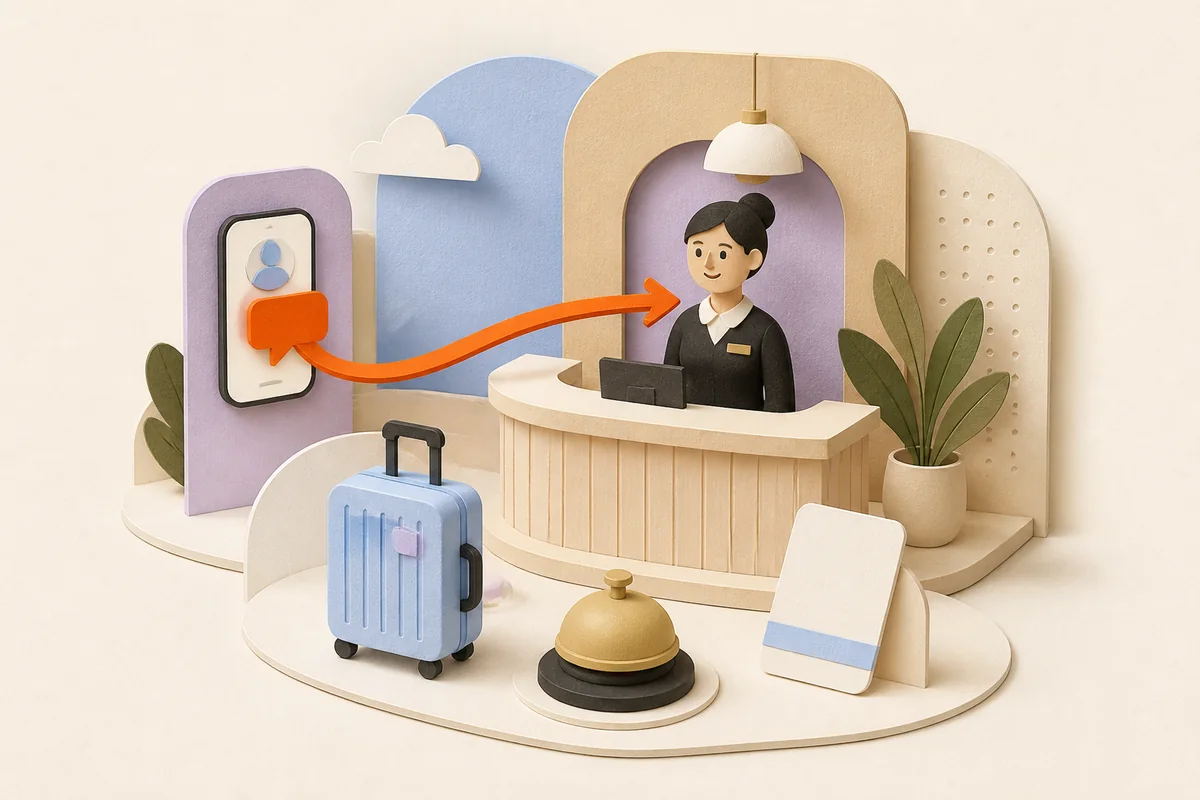
Guests often decide how responsive a hotel feels before they arrive. They ask about airport transfers on WhatsApp, room views beneath an Instagram post, check-in times in Messenger, and family amenities under a YouTube tour. During a stay, the same channels may carry an urgent service request.
Luni Chat helps hotels, resorts, hostels, and serviced apartments answer dependable questions across social channels while routing reservations, payments, and in-stay issues to the people and systems that own them.
Cover the guest journey, not just the FAQ page
Inspiration and selection
Travelers compare room types, location, breakfast, pools, spas, accessibility, children’s policies, parking, pet rules, and nearby experiences. Luni can answer these questions from approved property content and link to the relevant room or amenity page.
Booking preparation
The assistant can explain published check-in rules, accepted payment methods, deposit policies, transfer options, cancellation terms, and direct-booking steps. Rates and availability are live commercial data. Unless a real-time reservation connection confirms them, Luni should link to the booking engine or hand off rather than quote a price or promise a room.
Pre-arrival and in-stay support
Directions, transfer meeting points, luggage storage, breakfast hours, Wi-Fi instructions, and facility schedules are useful automation candidates. Noise complaints, room access, safety, medical needs, lost property, payment disputes, and service recovery deserve priority human attention.
After departure
Luni can explain the feedback, invoice-request, and lost-property processes. A negative public comment should receive acknowledgment and a private handoff, not a defensive automated debate.
Create property-specific knowledge
Hotel information changes by building, season, room, rate, and guest type. Store facts with those scopes visible.
- property address, time zone, contacts, and local directions;
- room names, occupancy, bed configuration, accessibility, and amenities;
- restaurant, spa, pool, gym, kids’ club, and transport schedules;
- check-in, identification, deposit, visitor, pet, and smoking policies;
- booking, modification, cancellation, and refund routes;
- renovation, closure, seasonal, and event notices with end dates;
- emergency, security, maintenance, and duty-manager escalation rules.
Assign the front office or operations team ownership of frequently changing content. Expired pool hours or an old airport pickup location can create a poor arrival even when the prose sounds polished.
Separate information from reservation actions
An assistant can explain what a room includes. It cannot know that a room is available tonight unless it receives current inventory. It can describe the published cancellation policy. It should not decide whether a particular guest receives an exception.
Use clear response patterns:
- Stable property fact: answer from the approved source.
- Live rate or availability: direct to the booking engine or reservations team.
- Existing reservation: verify identity in an approved workflow before revealing details.
- Change, cancellation, or refund: collect the booking reference privately and transfer.
- In-stay problem: prioritize by safety and service impact, then alert the right team.
Use each channel deliberately
Instagram and TikTok are strong discovery surfaces: keep public replies concise and move dates or personal needs into DM. WhatsApp works well for pre-arrival questions when the property has set expectations about response and consent. Messenger can bridge discovery and reservations. YouTube comments beneath property tours benefit from durable room and amenity facts, but old videos should point to current information.
Luni Chat’s channel coverage gives the property one knowledge-and-voice layer without requiring identical public replies everywhere.
Route handoffs to hotel operations
A generic “someone will get back to you” message is not enough. Route by situation:
- reservations for availability, changes, and group requests;
- front desk for arrivals and current stays;
- duty manager for service recovery and high-impact complaints;
- security or the property’s emergency process for immediate safety;
- events team for weddings, conferences, and group leads;
- finance for invoice and payment issues.
Include property, dates when volunteered, booking-reference status, language, conversation summary, urgency, and what has already been attempted. The guest should not have to repeat a long thread.
Test real hotel edge cases
Before launch, test a sold-out date, an early-arrival request, an expired promotion, conflicting room names, a guest asking about accessibility, an allergy question, a missing airport transfer, a midnight noise complaint, a public refund demand, and an old video showing an amenity that is closed.
Run these tests for every property. A multi-property group should never let one hotel’s parking or pet policy leak into another’s answer.
Govern a multi-property hospitality group
Groups need both shared brand knowledge and local operational truth. Central teams can own voice, loyalty-program descriptions, privacy language, and common escalation standards. Each property should own its room facts, hours, facilities, transport, temporary notices, and on-duty contacts.
Require Luni to establish the property before answering any fact that varies. A guest saying “your pool” beneath a group campaign may not have named a hotel. The assistant should ask which property rather than choosing the nearest or most prominent one. The same rule applies to restaurants, parking, check-in time, pet policies, and airport transfers.
Create a morning operational review for today’s closures and an expiry check for yesterday’s alerts. Before a major event, test late-arrival instructions, road closures, parking capacity language, and the handoff route after the reservations desk closes. During the event, review high-volume gaps in short cycles so one missing transport answer does not trigger hundreds of avoidable calls.
For in-stay cases, define who owns the conversation until resolution. An inbox transfer is not operational success if no department accepts it. Record acceptance and outcome for priority cases, then use post-stay review to identify whether the source, routing rule, staffing plan, or property operation caused the failure.
Measure guest and operational outcomes
Track correct-property answer rate, booking-engine clicks, reservation handoffs, time to accept in-stay escalations, repeat questions, knowledge gaps, and public complaints requiring correction. Segment pre-stay and in-stay response times because their urgency is different.
Do not attribute a booking to Luni merely because a guest received a reply. Use booking-engine or reservations data and a defined assisted-conversion window.
How Luni Chat helps hospitality teams
Luni Chat helps a hospitality team stay responsive across WhatsApp, Instagram, Messenger, Facebook, YouTube, and TikTok. It answers from the hotel’s approved knowledge, maintains a consistent service voice, captures inquiries in one inbox, and transfers reservation or guest-service cases with their context.
Start free with one property, one season’s current information, and the ten edge cases above. The most valuable first win is usually not a complex booking action; it is a reliable answer and a fast handoff at the moment a guest needs it.