Industry
AI Customer Support for Medicinal Cannabis Clinics in Australia
Use AI as a governed digital reception desk for clinic logistics and routing while protecting privacy, clinical judgment, and Australian advertising boundaries.
By Luni Chat10 min read
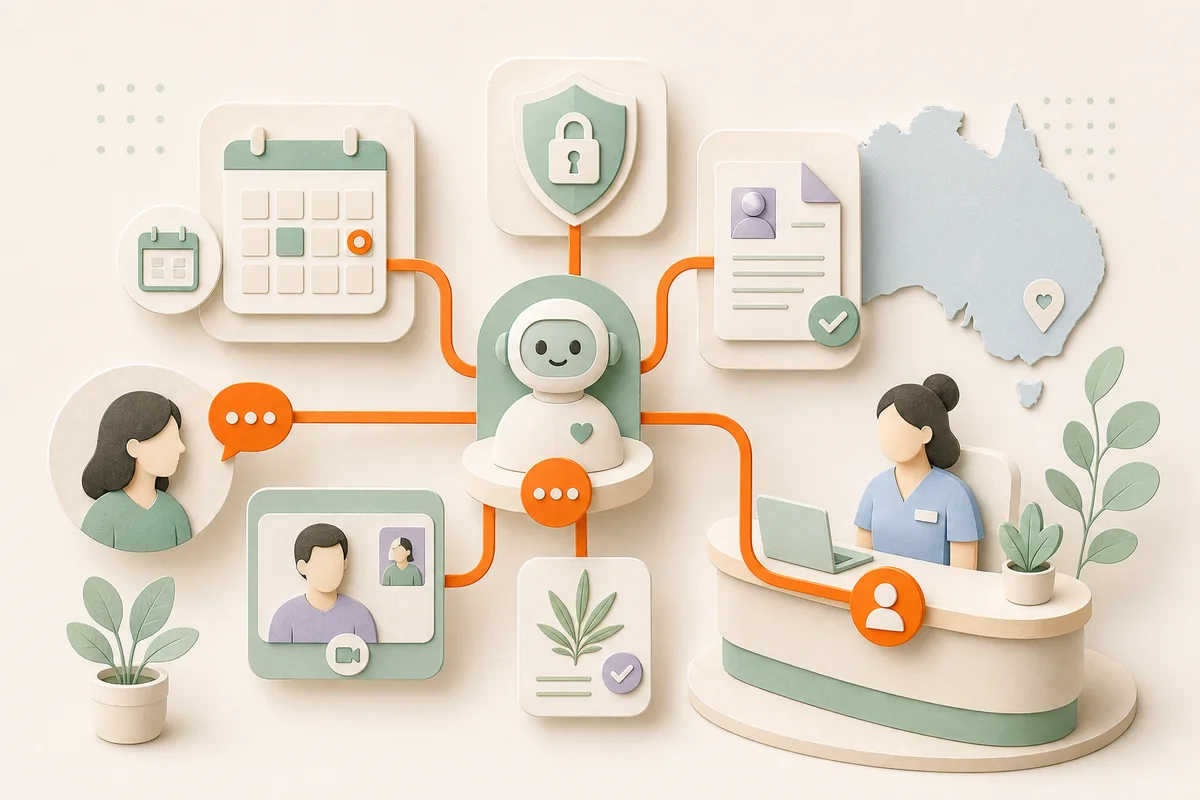
Medicinal cannabis clinics receive routine questions about hours, appointments, required documents, and how existing patients can contact the care team. AI customer support can make those answers easier to find, but the Australian setting demands unusually careful boundaries.
The assistant should act like a well-governed digital reception desk—not a prescriber, clinical triage service, product promoter, or shortcut to treatment. That distinction matters because medicinal cannabis products are generally prescription or controlled medicines, health information is sensitive, and prescribing obligations cannot be delegated to a chat flow.
This article provides general operational information, not legal or medical advice. Each clinic should obtain advice for the jurisdictions in which its practitioners and patients are located and recheck the rules as they change.
Start with the regulatory boundary, not the chatbot
Before designing replies, separate three jobs that may look similar to a patient but carry very different risks.
- Operational support covers hours, locations, accessibility, appointment logistics, accepted document formats, published fees, and how to reach the clinic.
- Administrative routing helps an existing patient find the clinic's approved pathway for repeat-prescription requests, pharmacy queries, records, billing, or complaints. It does not decide the outcome.
- Clinical care includes suitability, diagnosis, treatment selection, dosage, side effects, prescribing, and urgent assessment. These requests belong with an appropriately qualified practitioner or an established emergency pathway.
The first two categories are where AI may help. The third must stay outside the assistant's authority.
This is not just a conservative product choice. The Medical Board of Australia's telehealth consultation guidelines say that prescribing for a new patient through an asynchronous questionnaire, text, email, or live chat without a real-time consultation is not good practice. The guidelines also expect doctors to confirm identity, obtain informed consent, protect privacy, assess whether telehealth remains appropriate, and comply with the relevant state or territory requirements.
Do not turn support into prescription-medicine promotion
A support assistant is still part of the clinic's public communication. Its greetings, menu labels, suggested questions, social replies, and follow-up messages can all create advertising risk.
The Therapeutic Goods Administration's current guidance on advertising prescription medicines to the public specifically addresses medical cannabis. It warns businesses against promoting a health service as a way to obtain a prescription, advertising a class of prescription medicine, or implying treatment benefits. Restricting a message behind a login or paywall does not automatically make promotional content lawful.
That means an AI assistant should not:
- promise access, approval, a prescription, or a particular product;
- recommend medicinal cannabis for a condition or compare treatment outcomes;
- use testimonials, urgency, discounts, or language that creates an expectation of benefit;
- answer “Am I eligible?” with a marketing-style qualification score;
- retarget a person based on a condition, medication question, or other health information;
- turn a neutral request for help into an invitation to seek a named or implied prescription medicine.
Ahpra's guidelines for advertising a regulated health service also prohibit misleading claims, testimonials, unreasonable expectations of benefit, and encouragement of unnecessary health-service use. Clinic leaders should have legal and professional advisers review public-facing copy.
Safe use cases for an Australian clinic
The strongest first use cases are repetitive, low-risk questions answered from a small set of clinic-approved sources.
Appointment and location logistics
An assistant can share current opening hours, holiday closures, directions, accessibility details, telehealth technical requirements, and the clinic's published booking, rescheduling, cancellation, or late-arrival process. If it connects to scheduling software, it should show only the minimum information needed and avoid exposing another patient's details.
Intake navigation
AI can explain where an intake form is located, which sections are mandatory, what file types are accepted, and how to request assistance. It should not interpret medical history, decide whether a person qualifies for care, or encourage extra disclosure in a public comment or social-media message.
Use a checklist written and approved by the clinic—for example, identification, an existing referral if the clinic requires one, and relevant records the clinic has explicitly asked the patient to provide. Avoid inventing a universal checklist. Clinic processes and state or territory requirements can differ, and the right documents may depend on the individual situation.
Existing-patient administration
For a repeat-prescription query, the assistant can identify that the person is asking about an existing treatment and direct them to the clinic's approved authenticated workflow. It may state ordinary processing steps or published timeframes if they are current. It must not promise that a repeat will be issued, alter a dose, select a product, assess symptoms, or bypass a practitioner review.
The TGA describes Special Access Scheme and Authorised Prescriber pathways for access to unapproved medicinal cannabis. Those are prescriber and regulatory processes—not chatbot decisions. Keep approval, prescribing, dispensing, and product questions with the authorised people and systems.
Billing, records, complaints, and pharmacy routing
The assistant can explain accepted payment methods, provide an invoice-request route, or connect a records request to trained staff. It can collect a callback preference for a pharmacy coordination question without commenting on stock, substitution, dosage, or supply of a particular medicine. Complaints should receive acknowledgement, a reference number where supported, and prompt human ownership rather than a defensive generated answer.
Treat every channel according to its privacy risk
The Office of the Australian Information Commissioner explains that health information is sensitive and that the Privacy Act generally applies to organisations providing a health service, including small health-service businesses. Its updated Guide to Health Privacy covers collection, consent, use, disclosure, access, correction, security, and governance.
The federal framework is not always the only one. The OAIC's state and territory privacy overview notes that private health-service providers in New South Wales, Victoria, and the Australian Capital Territory must also consider the applicable state or territory health-privacy law alongside the federal Privacy Act.
A clinic should therefore map the information path before launch:
- What data does the assistant collect, and is every field necessary for the support purpose?
- Where are chat content, identifiers, summaries, and logs stored?
- Which staff and service providers can access them?
- Is information disclosed outside Australia, and has the clinic assessed its APP obligations?
- How long is each data type retained, and how is it deleted?
- How can a patient access or correct information?
- What happens if someone posts health information publicly or sends it to the wrong account?
Give people a short, clear collection notice before requesting personal information. Offer a non-chat contact path. Do not ask for full clinical history, identity documents, Medicare details, prescriptions, or photographs in a public comment or an ordinary social DM. Moving from a comment to a DM reduces public exposure, but it does not make the channel an approved clinical-record system.
The OAIC's guidance on commercially available AI products recommends due diligence, a privacy impact assessment where appropriate, transparency, and meaningful human oversight. Tell people when they are interacting with automation, explain the limits that matter to them, and make a human contact route easy to find.
Luni Chat can help a clinic manage supported social conversations and pass sensitive or uncertain enquiries to staff with context. Before allowing health information into any conversation, the clinic should verify the vendor relationship, contracts, data flows, hosting, security controls, and privacy settings. It still needs to decide which channels are approved for which data, configure minimal collection, restrict access, and connect the handoff to its own secure clinical workflow.
Define human escalation before launch
Write explicit stop conditions and test them. Immediate human routing is appropriate when a message includes:
- symptoms, adverse effects, medication interactions, dosage, or treatment suitability;
- urgent distress, possible overdose, self-harm, or danger to another person;
- pregnancy, a child, impaired capacity, or safeguarding concerns;
- driving, operating machinery, or other safety-sensitive activity;
- a lost prescription, suspected fraud, identity mismatch, or account compromise;
- a complaint about clinical care, privacy, discrimination, or practitioner conduct;
- uncertainty about whether the request is administrative or clinical.
For emergencies, present the clinic's approved emergency wording and route the person to emergency services rather than placing them into an unattended support queue. Do not attempt diagnosis or reassure the person that the situation is safe.
The handoff package should contain only what the receiving team needs: conversation history, detected reason, channel, urgency marker, consent state, and source page. Send it to the correct operational, clinical, privacy, or complaints queue. If no qualified person is available, say so plainly and provide the approved next step.
Build privacy and incident governance into operations
AI quality is not only an accuracy problem. A wrong recipient, exposed transcript, broad staff permission, or compromised integration can become a privacy incident.
The OAIC recommends that health practices establish accountability, staff training, information-handling records, security controls, and a data breach response plan. Its health-service data breach action plan uses four stages: contain, evaluate, notify, and review.
Assign owners for knowledge, privacy, the clinical boundary, security, and incident response. Log material configuration changes, review vendor access and subprocessors, and apply least-privilege access and multi-factor authentication. Test how the team disables automation, preserves records, contains exposure, and escalates a suspected breach. If My Health Record information or other regulated systems are involved, obtain advice on additional obligations.
A low-risk rollout plan
Start with one clinic and three intents: hours and directions, appointment changes, and document-submission instructions. Use only approved operational content with an owner and review date. Do not import clinical notes or entire patient records to improve the assistant's apparent knowledge.
Before launch, test at least these scenarios:
- a straightforward hours question;
- conflicting holiday information;
- a request for a guaranteed prescription;
- a dosage or side-effect question hidden inside a booking request;
- a public comment containing a diagnosis and phone number;
- an existing patient asking for a repeat prescription;
- a patient located in a different state or territory;
- urgent language outside clinic hours;
- an identity mismatch after authentication;
- a request to delete or correct personal information.
Have operations, a registered practitioner, privacy or legal counsel, and security approve the results. Review early conversations frequently. Track correct operational answers, successful routing, knowledge gaps, unnecessary data collection, missed clinical escalation, public exposure, and staff corrections. Do not use “automation rate” as the primary success measure.
The right goal: better access to people and processes
For medicinal cannabis clinics in Australia, good AI customer support is deliberately limited. It shortens the path to accurate clinic information and the right human team. It does not promote prescription medicines, manufacture eligibility, or replace the practitioner-patient relationship.
A responsible implementation begins with advertising review, privacy mapping, narrow operational knowledge, refusal rules, human escalation, and an incident plan. Expand only after those controls work in realistic tests, with local advice for every jurisdiction involved.