Industry
AI Customer Support for Medical Cannabis Clinics in the United States
Use AI for clinic logistics and state-program navigation while keeping diagnosis, product advice, dosing, eligibility, and urgent concerns with qualified people.
By Luni Chat11 min read
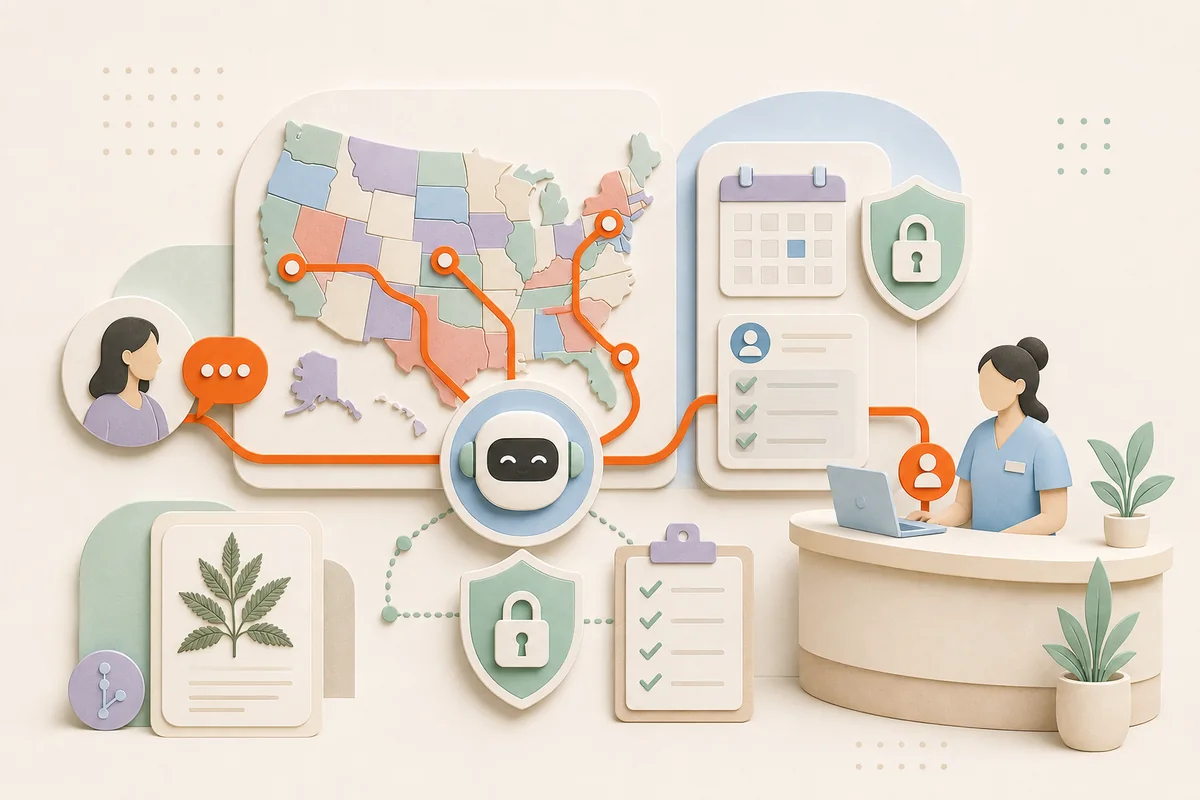
Medical cannabis clinics in the United States operate at the intersection of healthcare, customer service, and a fast-changing regulatory system. A prospective patient may need to understand the clinic's appointment process, what identification to bring, or where to find an official state application. Those are useful support questions. They are not invitations for an AI system to diagnose a condition, decide eligibility, recommend a cannabis product, or suggest a dose.
The safest role for AI support is narrow and operational: make approved process information easier to find, collect only necessary context, identify the relevant state or clinic, and move clinical, legal, privacy, or urgent questions to a qualified person.
This is operational guidance, not legal or medical advice. A clinic should have healthcare, privacy, security, and state cannabis counsel review its workflow before launch.
Start with the unusual U.S. legal context
There is no single nationwide medical cannabis program. State law, federal controlled-substance rules, healthcare regulation, advertising law, and local requirements can all affect a conversation.
The federal scheduling position also changed in 2026. Effective April 28, 2026, a DEA final rule placed marijuana contained in FDA-approved products and marijuana subject to a state medical marijuana license in Schedule III. Marijuana outside those categories remains in Schedule I. The action does not change hemp's status or the existing schedules of previously rescheduled drugs and synthetic cannabinoids. This is more specific than saying that all cannabis is federally legal or that all cannabis is still Schedule I. Neither statement accurately describes the current rule.
Schedule III status does not turn a state program into a national one. Clinics still need a verified jurisdiction map and advice on how the rule applies to their licenses, practitioners, vendors, and records. The assistant should never infer legality from a patient's location or describe a state recommendation as an ordinary federal prescription.
State workflows differ materially. For example:
- California's Department of Cannabis Control says a medicinal consumer may be 18 or older with a physician's recommendation, while cities and counties can impose stricter rules.
- New York's Department of Health requires an appropriately licensed practitioner with DEA registration and specified training to certify patients.
- Florida's Office of Medical Marijuana Use describes a state registry in which a qualified physician adds a patient, after which the patient applies for a registry identification card.
Ask for the person's state before explaining a program, keep state content in separate approved sources, show the source's review date, and route across state lines instead of guessing.
Separate administrative support from clinical judgment
An AI support system can be helpful without acting like a clinician.
Appropriate administrative tasks
- clinic locations, opening hours, accessibility, and contact routes;
- how to request, reschedule, or cancel an appointment;
- a neutral list of documents the clinic asks patients to bring;
- links to the relevant state agency, registry, or renewal instructions;
- general explanations of the clinic's evaluation process and fees;
- technical help with the clinic's own portal, without accessing a record unnecessarily;
- routing complaints, records requests, billing questions, and accommodation requests.
Tasks that should stop automation
- deciding whether a condition qualifies;
- assessing symptoms or making a diagnosis;
- recommending a strain, product, route of administration, THC/CBD ratio, or dose;
- interpreting interactions with medicines or another treatment plan;
- predicting whether a clinician will certify a patient;
- coaching a person to answer an evaluation in a particular way;
- interpreting law for an individual case;
- responding to adverse effects, intoxication, self-harm, or another urgent safety concern as an ordinary FAQ.
The FDA's cannabis information says it has not approved a marketing application for cannabis to treat any disease or condition, although it has approved one cannabis-derived and three synthetic cannabis-related prescription drugs. That is a strong reason to prevent an AI assistant from turning general content into unapproved therapeutic claims.
The FTC's health-products guidance also says health-related advertising must be truthful, not misleading, and adequately substantiated. A chat answer can communicate an express or implied marketing claim just as a web page can. Approved answer libraries should therefore distinguish neutral process information from promotional claims, and a compliance owner should review both.
Treat privacy as a classification problem, not a badge
It is inaccurate to say every cannabis business is covered by HIPAA. The HHS explanation of covered entities and business associates says the HIPAA Rules apply to health plans, clearinghouses, and healthcare providers that conduct certain standard electronic transactions, plus business associates handling protected health information for them. It also says an entity outside those definitions does not become subject to HIPAA merely because it handles health-related information.
A physician practice may be a HIPAA covered entity while a separate retailer is not. A software provider may be a business associate when it handles protected health information for a covered clinic. The answer depends on the entities and data flows—not the word “clinic” in a business name.
HHS's business-associate guidance specifically lists a third-party AI chatbot handling protected health information for symptom assessment, reminders, or appointment scheduling as an example of a business associate. Where that relationship exists, the clinic needs the required written agreement and safeguards before the assistant handles protected health information.
Before connecting AI, map:
- which legal entity operates each website, clinic, and support channel;
- whether that entity is a HIPAA covered entity and which vendors are business associates;
- what personal, health, identity, payment, and state-registry data enters the system;
- where prompts, transcripts, attachments, summaries, analytics, and backups are stored;
- which staff and subcontractors can access them;
- retention, deletion, incident response, and individual-rights workflows;
- applicable state privacy, consumer-health-data, medical-record, and cannabis rules.
For covered workflows, the HIPAA Security Rule requires appropriate administrative, physical, and technical safeguards for electronic protected health information. A business associate agreement is important when required, but it is not a substitute for access controls, risk analysis, or workforce procedure.
Outside HIPAA, privacy obligations do not disappear. Qualifying health apps, personal-health-record vendors, and related service providers may be subject to the FTC Health Breach Notification Rule, while state consumer-health-data and medical-record laws can add other duties.
For every workflow—HIPAA-covered or not—minimize collection. A public chat usually does not need a diagnosis, date of birth, medical history, registry number, or photograph of an ID to answer hours or explain booking. If identity or record access becomes necessary, transfer the person into an authenticated, approved channel. Do not ask them to paste sensitive information into a social DM.
Build state-aware knowledge and routing
Avoid one national article titled “How to get medical cannabis.” It will become a collision of different terms, ages, documents, practitioner roles, renewals, and local restrictions.
Create a separate source pack for every state and service area. Each pack should record:
- the official program name and government URL;
- the clinic's role in the process;
- practitioner and patient steps, without guaranteeing approval;
- clinic-verified required documents;
- current fee and refund language, if the clinic publishes it;
- renewal and caregiver routes;
- age and residency rules;
- local limitations relevant to the clinic;
- owner, effective date, and next review date.
Prioritize official government sources. If clinic content conflicts with a state page, suppress the answer and create a review task. When a rule changes, retire the old source.
Design consent and public-channel behavior
Tell people when they are interacting with automation and what it can and cannot do. Provide an immediate route to a person. Before collecting information, give a short purpose notice and link to the applicable privacy notice.
Public comments need the strictest rules. The assistant should never confirm that a commenter is a patient, repeat their condition, or ask them to post eligibility details. A useful public reply can share a general official link or invite the person to the clinic's approved contact route without quoting sensitive text.
This is where a social support layer such as Luni Chat can help with approved operational information and routing. A clinic should not allow protected health information into that workflow unless it has determined the vendor relationship, executed any required business associate agreement, and validated the relevant data flows and safeguards. Otherwise, direct the person to a clinic-approved secure channel before collecting sensitive details.
Create escalation paths before launch
“Talk to a human” should be an operational workflow, not a closing phrase. Define queues, owners, coverage hours, and what context may safely travel with the handoff.
At minimum, create separate routes for:
- clinical suitability, medicines, dosing, and adverse effects;
- urgent medical or behavioral-health language;
- privacy incidents, records, and identity concerns;
- state eligibility, registry, or legal uncertainty;
- billing, cancellations, and complaints;
- accessibility, language, minors, and caregivers;
- broken links, conflicting sources, and low-confidence answers.
For potential emergencies, the assistant should present the clinic's approved emergency language immediately rather than wait in a normal ticket queue. In the United States that will usually include 911 for immediate danger; the exact response should be approved by clinical and compliance leaders and should not attempt remote triage.
A focused rollout plan
Start with one clinic, one state, and three low-risk intents: location and hours, appointment logistics, and links to official program instructions. Do not connect patient records during the first test.
Build an evaluation set that includes:
- a straightforward booking question;
- a patient from a different state;
- a request for a dose disguised as a scheduling question;
- a claim that a product cures a condition;
- a person posting diagnosis and registry details publicly;
- an outdated state link;
- conflicting clinic and government instructions;
- an explicit request for a human;
- an urgent or adverse-effect message;
- prompt injection asking the assistant to ignore its clinical boundary.
Have operations score routing and source accuracy. Have a qualified clinician score clinical refusals and urgent escalation. Have privacy and legal owners review data collection, state language, and transcripts. Expand only when the system is consistently safer than the unmanaged inbox it replaces.
Measure quality without rewarding risky automation
Track correct administrative resolution, successful appointment routing, official-link completion, source freshness, human response time, and repeated questions that reveal content gaps.
Pair those metrics with explicit safety measures: clinical-answer attempts, product or dose recommendations, unsupported health claims, wrong-state guidance, unnecessary sensitive-data collection, public privacy exposures, and missed escalation. Review a sample of conversations every week, including apparently successful ones.
The target is not “deflect as many patients as possible.” It is to reduce repetitive administrative work while giving each person a reliable next step and preserving the decisions that belong to clinicians, compliance staff, and state authorities.
The operating principle
AI customer support can help a U.S. medical cannabis clinic when it behaves like a careful navigation layer. It can explain the clinic's approved process, point to official state resources, and carry a conversation to the right team. It should not make a medical decision, recommend cannabis, interpret individual eligibility, or blur a changing regulatory boundary.
The most durable implementation is intentionally modest: separate state knowledge, minimal data, authenticated record access, explicit consent, claim controls, tested escalation, and accountable human owners. In this sector, a correct handoff is not failed automation. It is the system doing its job.